Hand or controller: which makes raycasting faster and easier in mixed reality?
This study was conducted as part of a three-week quantitative research course at IDC, IIT Bombay.
We compared hand and controller raycasting in a mixed-reality target-selection task to understand how the input method affects speed, accuracy, ease of use, and preference.
Akshay R Nair
Kanishk Kamal
Srishti Rachna
Tanushree Pillai
Does the input method change how people perform in mixed reality?
Improvements in hand-tracking hardware since 2019 have made direct hand input a practical alternative to controllers in mixed reality. What remains less clear is how that choice affects performance.
We asked whether
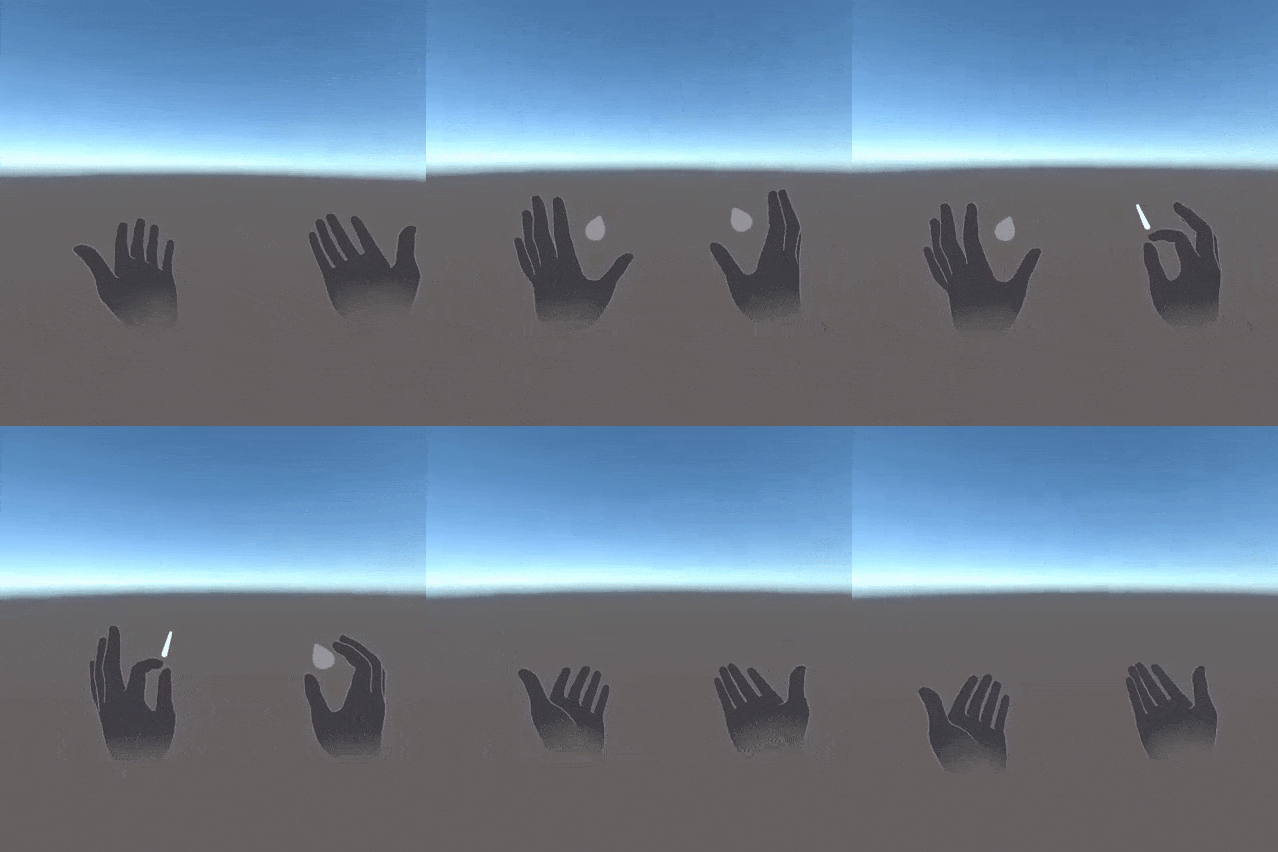
Hand raycasting
Hand tracking removes the physical device, using the direction of the hand and a pinch gesture to point and select.
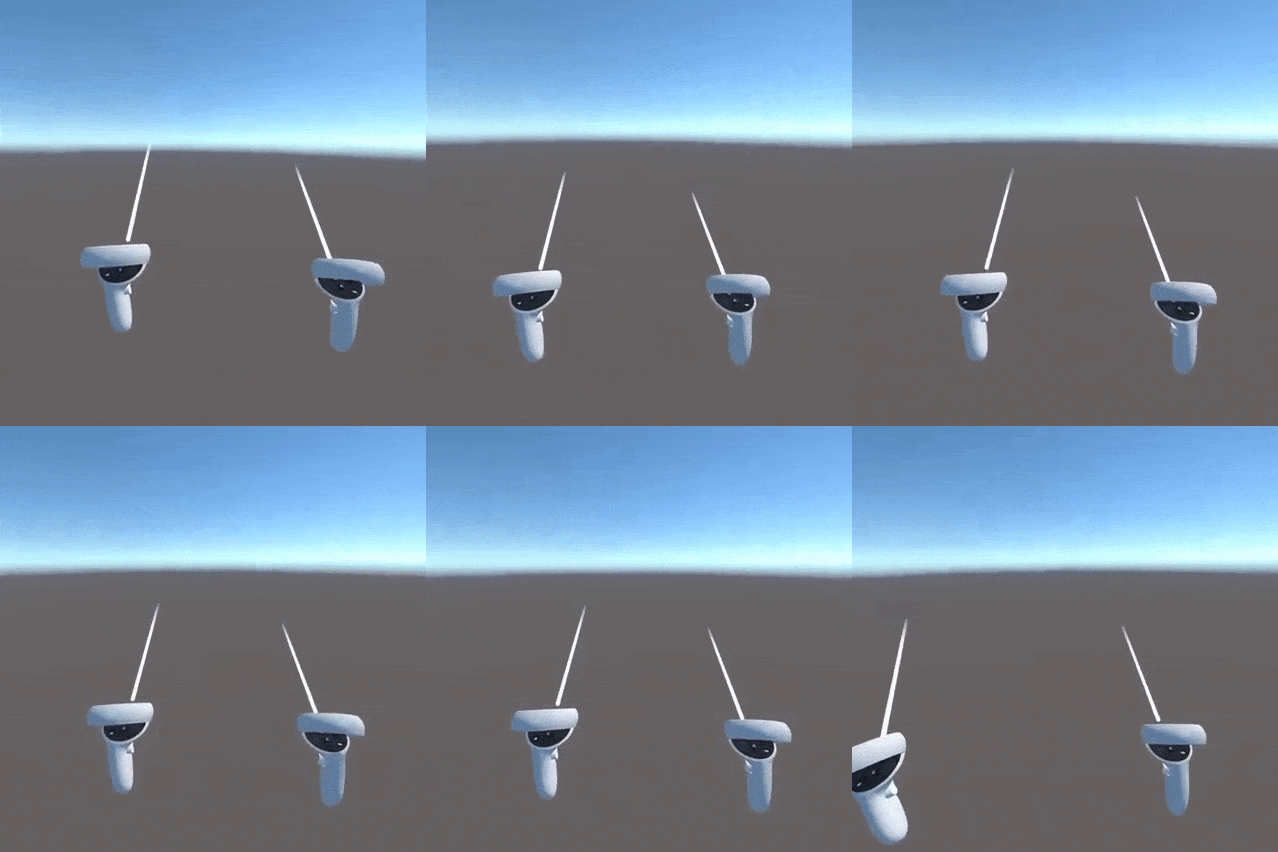
Controller raycasting
A tracked controller provides a stable pointing ray, a physical trigger, and haptic feedback during target selection.
Controllers were faster and easier, but not more accurate
Speed
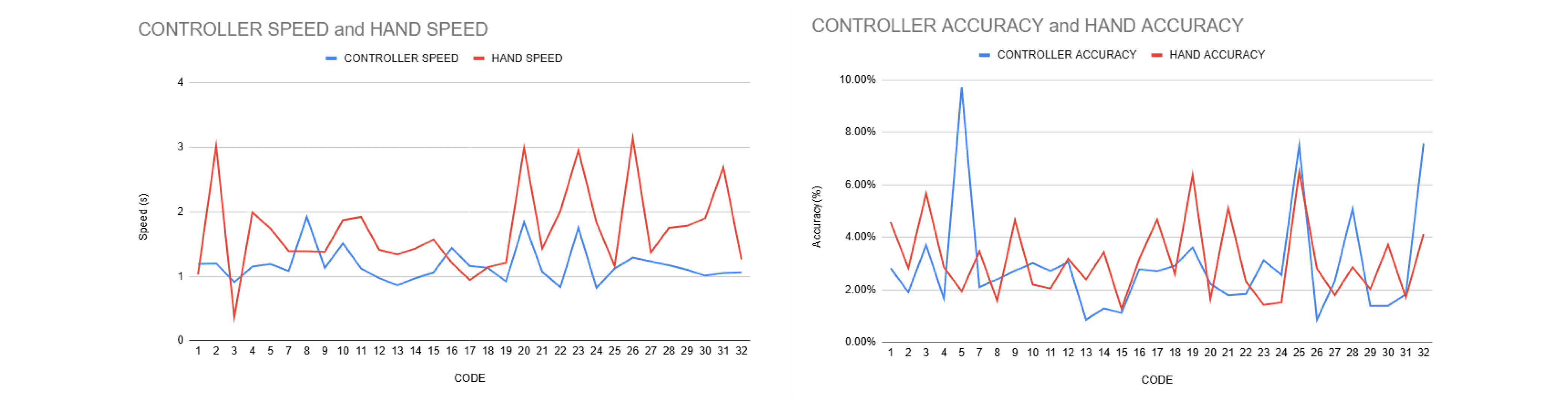
Controller raycasting was significantly faster. Participants averaged 1.2 seconds with the controller and 1.7 seconds with hand raycasting.
Accuracy
The study found
Ease and preference
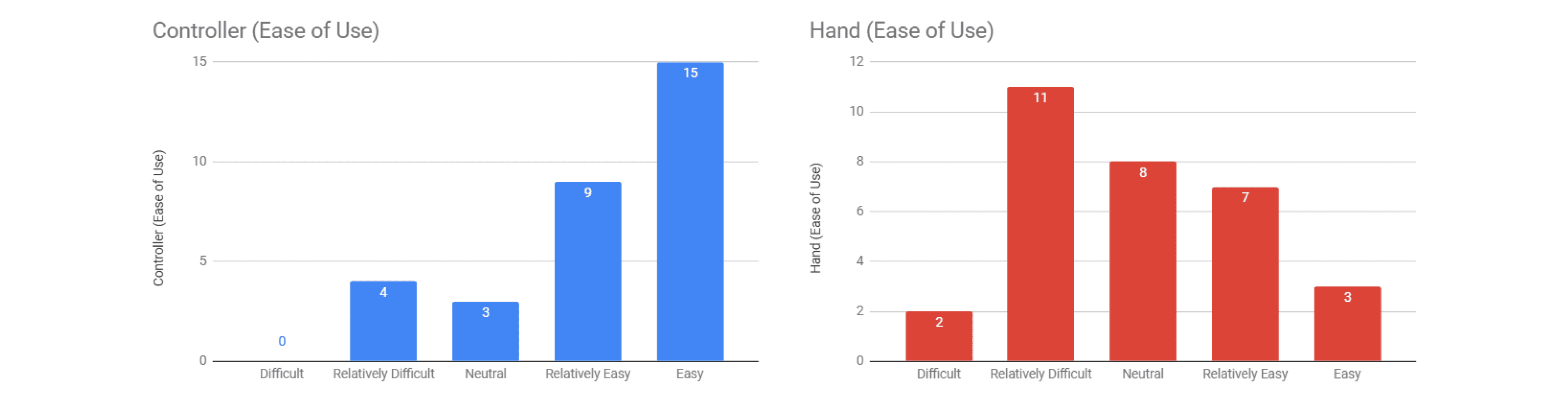
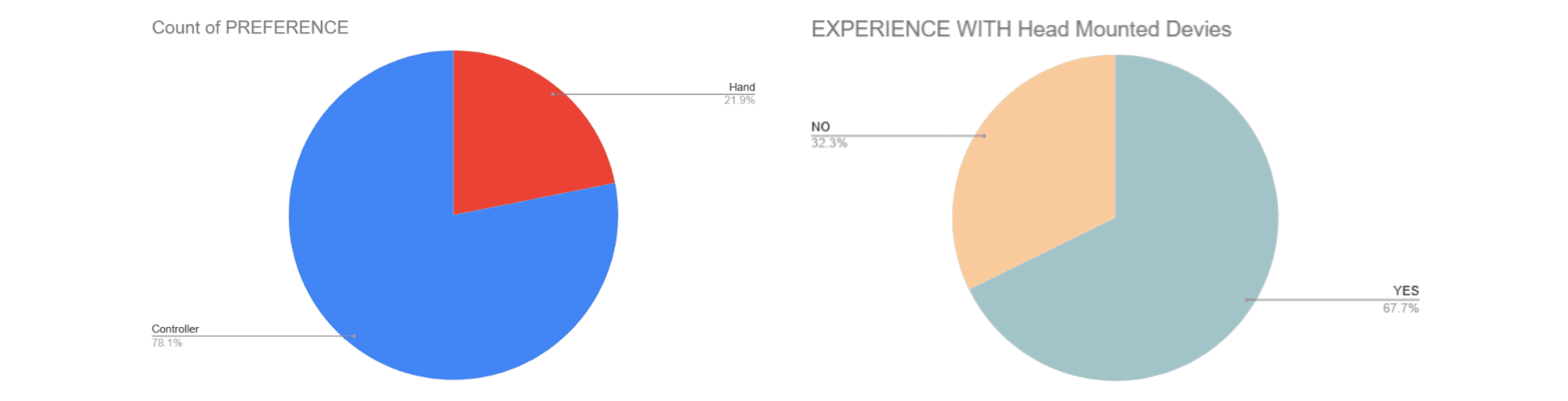
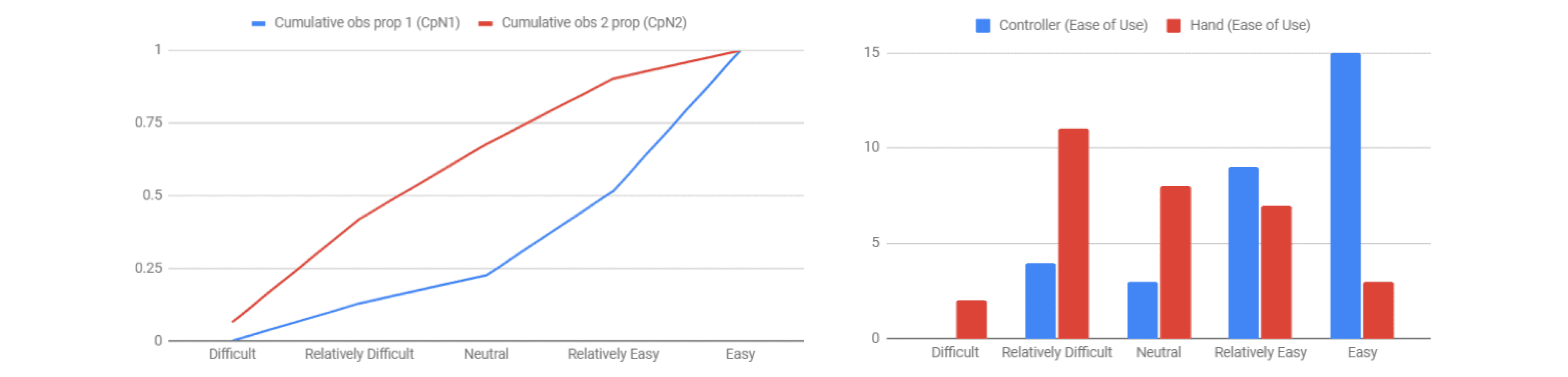
Controller raycasting was rated easier to use and was the more commonly preferred input method.
Positioning the study in existing 3D-selection research
We reviewed A Survey of 3D Object Selection Techniques for Virtual Environments by Ferran Argelaguet and Carlos Andújar (2013) and Raycasting in Virtual Reality by Krzysztof Pietroszek (2018).
These works helped us understand established object-selection methods and the principles behind ray-based interaction in virtual environments.
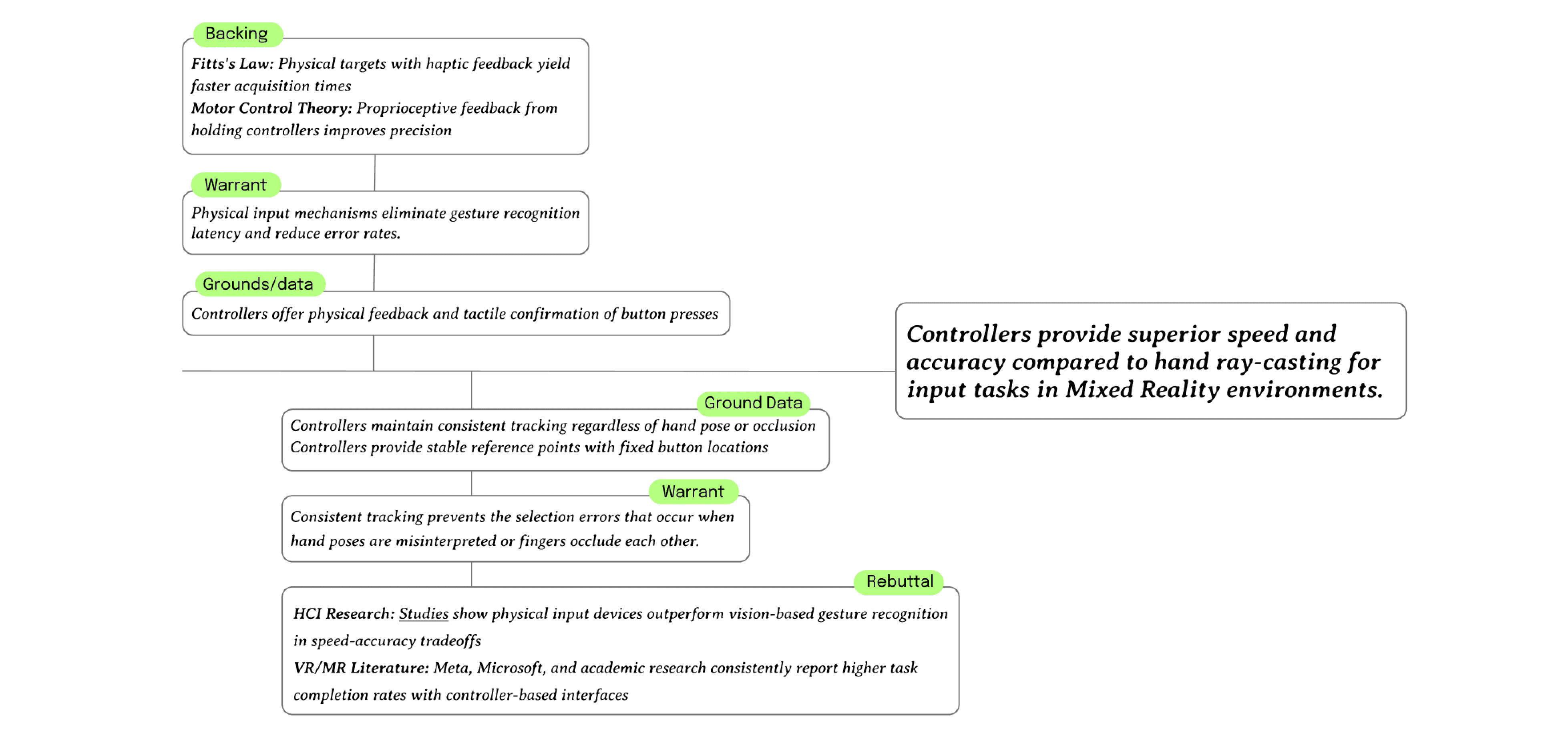
Prior work positions controller
Would the controller produce a measurable performance advantage?
Null hypothesis
There is no significant difference in the speed and accuracy of tasks performed with controller and hand raycasting in an MR environment.
Alternate hypothesis
Using a controller results in significantly higher speed and/or significantly higher accuracy than using hand raycasting for input tasks in an MR environment.
The theoretical argument was that controllers should perform better because haptic feedback removes ambiguity at the moment of selection, consistent tracking reduces gesture misinterpretation, and proprioceptive feedback supports precise motor control.
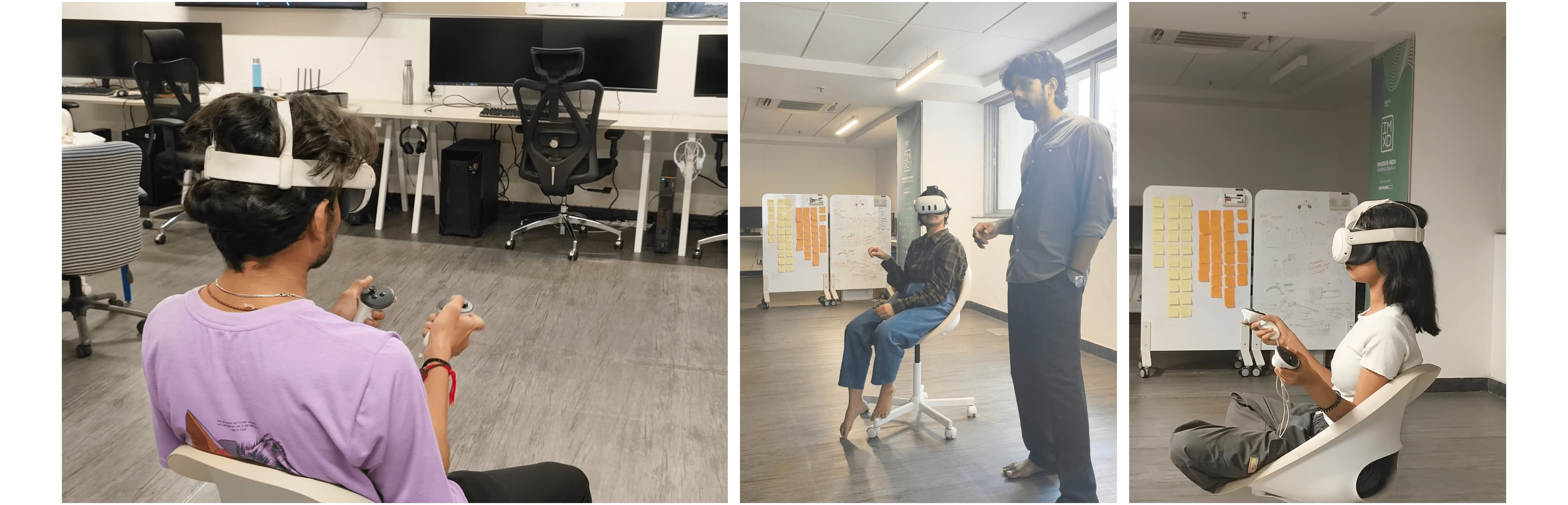
Conducted a within-subjects experiment on Meta Quest 3
Study setup
- Experimental, within-subjects design
- 32 participants
- Independent variable: raycasting method
- Conditions: controller and hand input
Controls
- The same MR environment and Meta Quest 3 headset
- Equal practice time: 10 attempts per method
- Counterbalanced task order
Experiment
Participants selected a sequence of targets using both input methods. The application recorded their average selection time and distance from the centre of each target across 30 attempts.
After each condition, we captured the participant’s preferred method and asked them to rate its ease of use on a five-point Likert scale.

What we collected
We combined application telemetry with self-reported measures so that the study captured both task performance and the experience of using each input method.
| Metric | Instrument | Measurement | Scale |
|---|---|---|---|
| Speed | Application | Average time taken to hit 30 targets | Seconds |
| Accuracy | Application | Average distance from the target centre across 30 attempts | Percentage |
| Preference | Verbal response | Preferred method: hand or controller | Binomial |
| Ease of use | Likert scale | Easy, relatively easy, neutral, relatively difficult, or difficult | Ordinal |
The distributions before significance testing
We visualised the raw distributions for task speed, accuracy, input preference, and ease of use before choosing tests appropriate to each measure.
Testing performance and perceived ease
We used paired t-tests for speed and accuracy because each participant completed both input conditions. The reported analysis contains 31 observations per condition.
We used an independent Kolmogorov-Smirnov test for the ordinal ease-of-use distributions, and included Spearman correlation in the analysis plan for the relationship between speed and accuracy.
Paired t-test: speed
The 95% confidence interval for the difference in speed was −0.79 to −0.29 seconds, with p < 0.05.
| Statistic | Controller | Hand |
|---|---|---|
| N | 31 | 31 |
| Sample SD | 0.3 s | 0.7 s |
| Observed mean | 1.2 s | 1.7 s |
| Paired t | −2.477 | — |
| Degrees of freedom | 30 | — |
| Two-tailed p-value | 0.00004277 | — |
Paired t-test: accuracy
The 95% confidence interval for the controller-minus-hand accuracy difference was −0.94 to 0.58, with p > 0.05.
| Statistic | Controller | Hand |
|---|---|---|
| N | 31 | 31 |
| Sample SD | 2.0 | 1.5 |
| Observed mean | 2.9 | 3.1 |
| Paired t | −0.731 | — |
| Degrees of freedom | 30 | — |
| Two-tailed p-value | 0.6284 | — |
Kolmogorov-Smirnov test: ease of use
| Statistic | Value |
|---|---|
| D statistic | 0.452 |
| Critical D at α = 0.01 | 0.414 |
| Critical D at α = 0.05 | 0.345 |
| N | 31 |
Because 0.452 > 0.345, the ease-of-use distributions differed significantly at α = 0.05.
Physical feedback improved efficiency without changing precision
Controller raycasting produced a clear speed advantage and was perceived as easier to use. However, the accuracy results did not support a meaningful difference between the two methods.
The input device therefore changed
Testing the limits of each input method
Target size and distance
Mixed reality adds depth: targets can vary across the Z-axis as well as in size. A Fitts’ Law-style follow-up could model how those factors change the trade-off between hand and controller raycasting.
Fine motor skills
Future experiments could compare the two input methods in more precise tasks, such as drawing or manipulating small virtual objects.
We thank Prof. Anirudha Joshi and Prof. Karthikeyan for their guidance throughout the course, and Prof. Jayesh Pillai for supporting the VR experiment setup at the IMXD Lab, IDC.