AeroSense

AeroSense

Project Summary

In my final year of engineering, my team and I designed AeroSense, an IoT system that tackles two invisible but dangerous health issues: air pollution and sleep apnea.

Formally presented at the 2024 IEEE Fourth International Conference on Power, Control and Computing Technologies (ICPC2T) and now published on the IEEE Xplore Digital Library.

Results

  • 98.6% accuracy in detecting air quality & apnea events
  • Built for just ₹8k — far cheaper than commercial devices
  • Combined environmental + personal health monitoring in one system
  • Real-time mobile app for alerts and insights

All technical details, including testing methodology, accuracy benchmarks, and references, are documented in our research paper.

Role

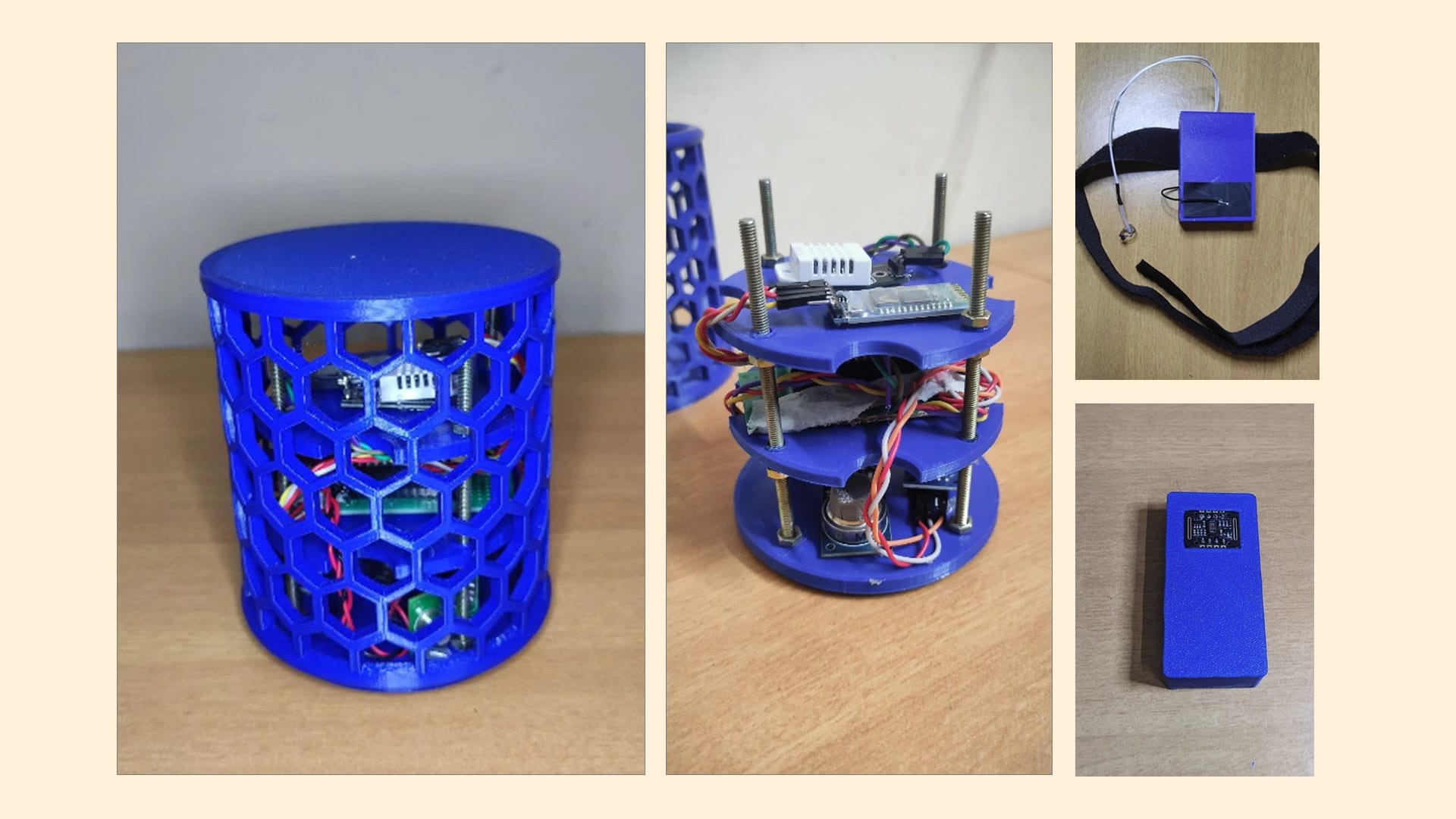
In our 4-member team; Arevind, Vaishnavi, Prince and Myself, responsibilities were distributed across sensing, electronics, data transmission, and structural design. I focused on the Design and Fabrication of the Air Quality Monitoring Module, covering enclosure logic, sensor placement, and thermal interference reduction.

Project Framing

AeroSense is a low-cost diagnostic tool for early detection of Obstructive Sleep Apnea (OSA) in home settings — especially where lab tests are inaccessible. Existing systems = expensive, fragmented.

Key Directions:

  • Keep costs low without sacrificing core diagnostic accuracy
  • Ensure sufficient accuracy for reliable early-stage screening
  • Design for modular sensor expansion
  • Optimize for low power, small footprint
  • Enable local manufacturing (no proprietary dependencies)

Example: A middle-aged user with snoring issues and hypertension uses the device over several nights. Anomalies in oxygen saturation and CO₂ levels prompt a hospital visit — catching OSA risk early.

Design Goals for Air Quality Module:

  • Maximize strength-to-weight ratio
  • Minimize material and production cost
  • Ensure high ventilation for accurate sensing
  • Isolate heat-sensitive sensors from interference
  • Support modular expansion
  • Maintain compact, bedside-suitable form factor

Form Development

Initial sketches explored horizontal vs. vertical stacking. Final concept adopted a tower-based structure to promote airflow, isolate sensing zones, and minimize footprint.

To balance cost and strength, a honeycomb lattice shell was implemented — offering material efficiency and rigidity. All parts were designed (in AutoCAD) for 3D printing using PLA.

We tested out the final product and found the readings to be great. There weren’t any heat bleed which was one of our main concern.

The alert and status interface was developed using MIT App Inventor, prioritizing functionality over visual polish.

Impact

The project pushed us to learn beyond our core domains and work as a tightly aligned team. We later conducted seminars for juniors, sharing our process, design decisions, and learnings from building the system from scratch.

All technical details, including testing methodology, accuracy benchmarks, and references, are documented in our research paper.

changelog

June 13, 2026

Transitioned projects grid to CSS column-count masonry layout, resolving lopsided column heights on iPad and maintaining a fluid vertical stagger.

June 13, 2026

Unified all card titles to display serif typography (Crimson Pro) at weight 400. Aligned site side paddings (navbar, homepage container, footer) to 24px.

June 13, 2026

Replaced footer credit with a native Changelog popup modal to easily track manual updates.