Beyond the Mouse: exploring tangible affordances of everyday things in digital navigation
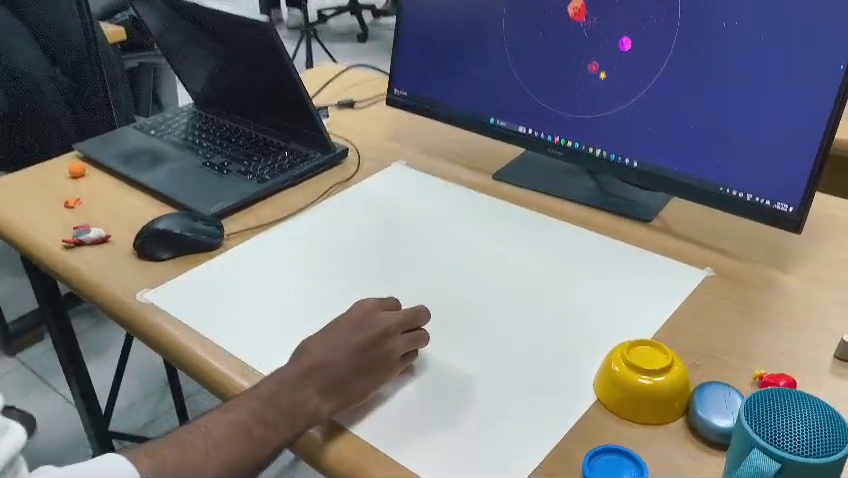
This project was developed as part of an Interaction Design course at IDC, IIT Bombay. Guided by Prof. Jayesh Pillai & Prof. Jayti Bandopadhyay.
This is an exploratory project to recognise everyday objects for digital navigations, and the leveraging the affordances they bring to the table.
Akshay R Nair
Riddhi Ashokkumar
Rohit Waghmare
What if everyday things could help us navigate the digital world?
Everyday objects come with their own familiar interaction affordances. A glass invites holding, tilting, and pouring; a knob invites turning. These physical qualities can sometimes offer a more intuitive mode of interaction than a mouse on a 2D plane.
This exploration looked at using
The challenge was to sense these movements reliably and distinguish intentional interactions from everything else happening around the object.
Tracking the object from below
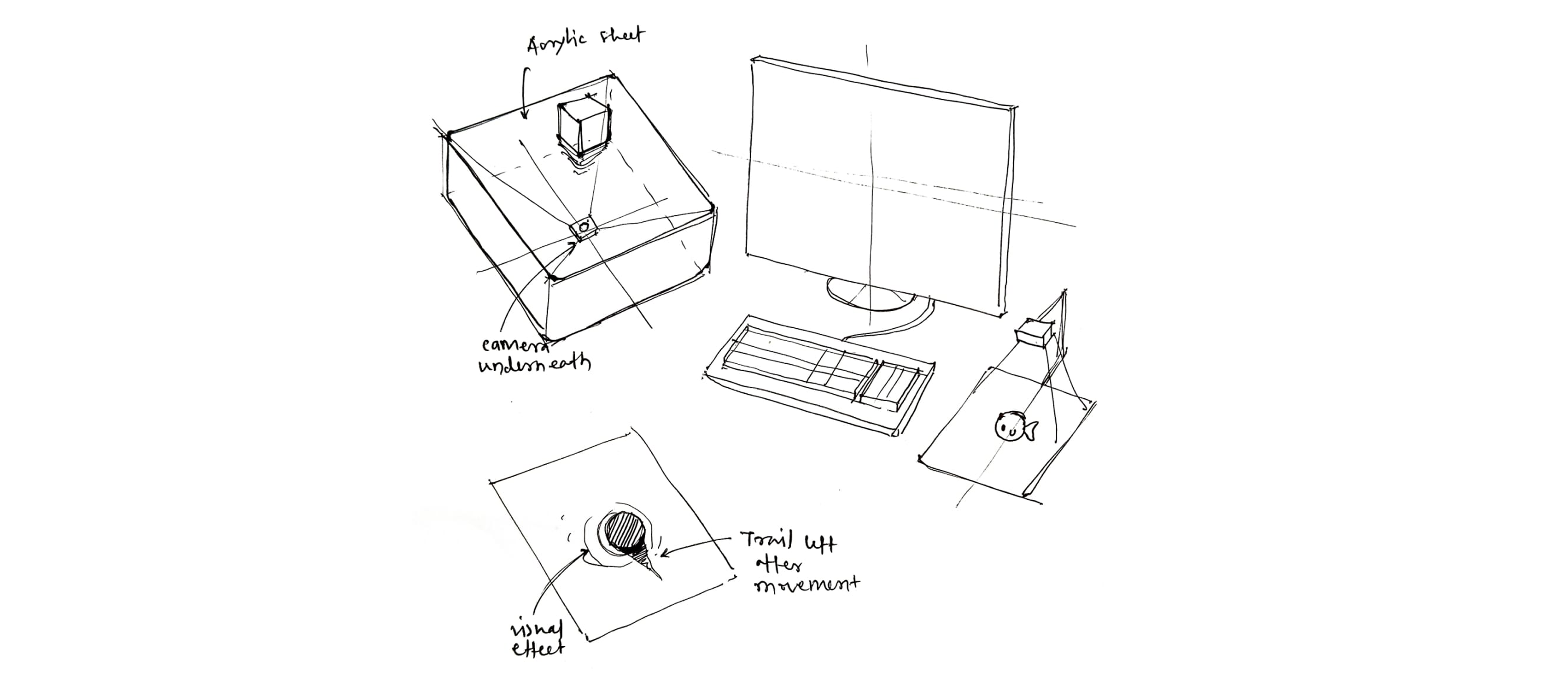
Our first prototype used an opaque surface with a camera underneath.
A Python script tracked contrasting blobs rather than identifying specific objects, which made the system considerably accurate and allowed almost any opaque object to be used as an input.
The limitation was that the object needed to
A palm resting on it could also be detected as a blob, making it difficult to distinguish the intended object from the hand manipulating it.
Using depth to isolate movement and tilt
Kinect gave us much
We first scanned the environment without the object, then introduced the object into the scene. Then by subtracting the background scan from the new depth reading, we could isolate and track the object reliably.
Relying on the depth sensors and outdated software, we managed to roughly detect movement and tilt of object.
The main limitation was physical setup. Kinect
Occulusion still remains an issue when using any camera setup.
Reading movement from above
We moved the camera above the interaction surface.
Initially, we considered using contrasting stickers as markers, but instead
Occlusion remained a limitation, so we turned it into an interaction. Intentionally covering the object, such as waving a hand above it, could trigger actions like a right-click.
Depth was estimated through scale: as the object moved closer to the camera, it appeared larger in the frame. This allowed us to detect lifting, although tilt could not be tracked reliably.
This became the most practical setup, combining object tracking, depth cues, and intentional occlusion without requiring additional markers.
Bringing the exploration into people's hands
For the exhibition, we turned the system into a space-shooter game where visitors could choose any everyday object and use it to control the spacecraft.
Moving the object across the surface controlled the ship in 2D, lifting it triggered a speed boost, and tapping it on the surface fired a shot.
Instead of designing a new controller and asking people to learn it, the interaction could emerge from the familiar ways they already handle everyday objects.
The exploration showed how movement, lifting, tapping, and even occlusion could become meaningful digital inputs, allowing ordinary objects to temporarily take on entirely new interactive roles.